Resume Writing
The Resume Standard: Build a Job Application That Holds Up
Most resume advice is too small.
It tells you to use action verbs, keep the resume short, add keywords, avoid typos, and write a cover letter if the employer asks. All of that is useful, but it does not answer the harder question:
What should a complete job application prove?
A strong resume or CV is not just a document. It is a case. It tells a busy reader:
- what role you are aiming for
- what evidence shows you can do the work
- what skills and judgment you bring
- why your background makes sense for this job
- what they should ask you about in the interview
That is the standard this guide uses.
The goal is not a pretty file. The goal is a readable, honest, role-specific application package that survives three moments of scrutiny:
- A system or recruiter scans it quickly.
- A hiring manager asks whether the evidence matches the job.
- An interviewer asks you to explain the story behind the bullets.
If your resume, CV, cover letter, and interview answers all support the same story, your application becomes easier to trust.
The Resume Standard In One Page
Before the details, here is the standard.
A strong resume or CV should be:
- Targeted: built for a role, not for every possible version of you.
- Readable: easy to skim, easy to parse, and easy to understand without explanation.
- Evidence-based: built around proof, not adjectives.
- Specific: clear about tools, scope, level, outcomes, and context.
- Honest: strong enough to help you, but not inflated beyond what you can defend.
- Structured: organized so the most relevant proof appears early.
- Consistent: aligned with your cover letter, LinkedIn profile, portfolio, and interview answers.
- Reusable: easy to adapt for the next role without starting over.
If a resume does those eight things, it is already ahead of most resumes.
Start With The Job, Not The Template
The biggest resume mistake is starting with design.
Templates matter. Formatting matters. ATS readability matters. But the first question is not "Which template looks best?" It is:
What job is this document trying to win?
Read the job description and separate it into four buckets:
| Job description signal | What to look for | Resume response |
|---|---|---|
| Core responsibilities | What you will do every week | Experience bullets that prove similar work |
| Required skills | Tools, methods, credentials, domain knowledge | Skills section plus proof in work/projects |
| Seniority signals | Ownership, scope, ambiguity, leadership | Examples of judgment, tradeoffs, and impact |
| Repeated language | Phrases that appear more than once | Natural keywords, not keyword stuffing |
Do this before writing. A resume that is not aimed at anything specific becomes a storage unit for your past. A resume that is aimed at a role becomes an argument.
Useful workflow:
- Paste the job description into a document.
- Highlight the repeated responsibilities and must-have skills.
- Mark the 5-7 requirements you can prove best.
- Build the resume around those requirements.
- Remove or shorten details that do not help this application.
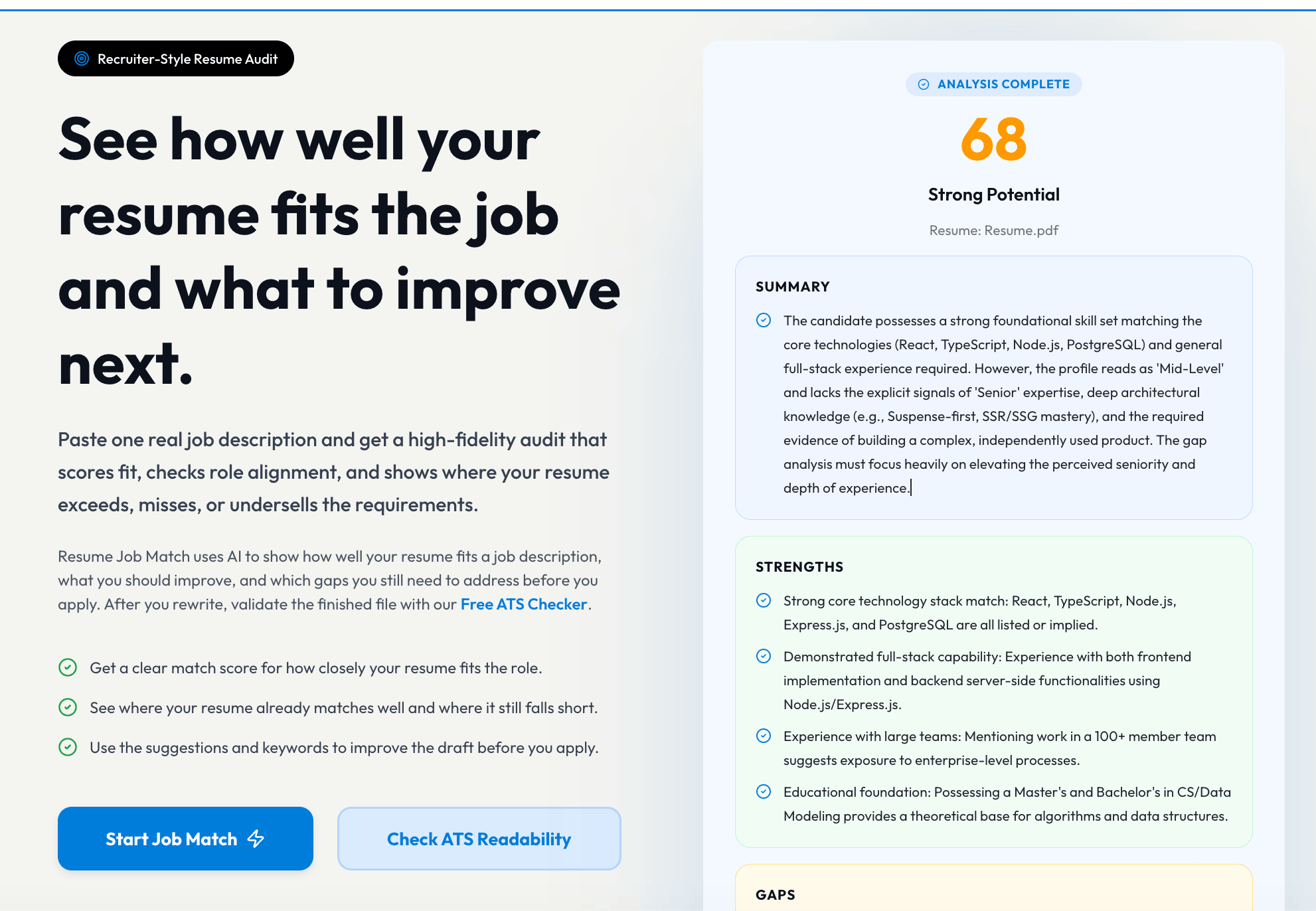
You can do this manually, or use Resume Job Match to compare your resume with a job description and find gaps.
Resume, CV, And Cover Letter: Do Not Make Them Do The Same Job
People use "resume" and "CV" differently depending on country and industry. In many everyday job applications, the terms overlap. In academic, research, medical, and international contexts, a CV can be longer and more detailed.
The important distinction is not the label. It is the purpose.
| Document | Main job | Best use |
|---|---|---|
| Resume | Show role fit quickly | Most job applications |
| CV | Show a fuller record of professional or academic work | Academic, research, medical, international, grants, fellowships |
| Cover letter | Explain fit, motivation, context, or transition | Targeted applications where story matters |
| Support discovery and credibility | Recruiters, networking, public proof | |
| Portfolio | Show work samples | Design, writing, engineering, product, data, creative roles |
Do not force one document to carry every burden.
If your resume has to explain a career change, an employment gap, a relocation, and why you love the company, it will become bloated. Let the resume prove fit. Let the cover letter explain context. Let the interview expand the story.
The Four Questions Every Resume Must Answer
A resume should answer four questions fast.
1. What job are you aiming for?
The top third of the resume should make the target role obvious. That does not mean you need a giant headline, but the combination of title, summary, skills, and recent experience should point in the same direction.
Weak signal:
Experienced professional seeking a challenging role where I can use my skills.
Stronger signal:
Product analyst with 4 years of experience building dashboards, analyzing activation funnels, and turning customer behavior data into roadmap recommendations for SaaS teams.
The second version gives the reader a target, a function, a level, a domain, and evidence categories.
2. What proof do you have?
Proof is not only numbers. Metrics help, but proof can also be scope, complexity, frequency, tools, stakes, or quality.
Good proof can include:
- revenue, cost, time, retention, conversion, speed, defect, or volume metrics
- team size, customer size, project size, budget, territory, or system scale
- before-and-after changes
- tools and methods used
- decisions made under constraints
- examples of ownership, collaboration, or recovery from problems
Weak bullet:
Responsible for customer reports.
Stronger bullet:
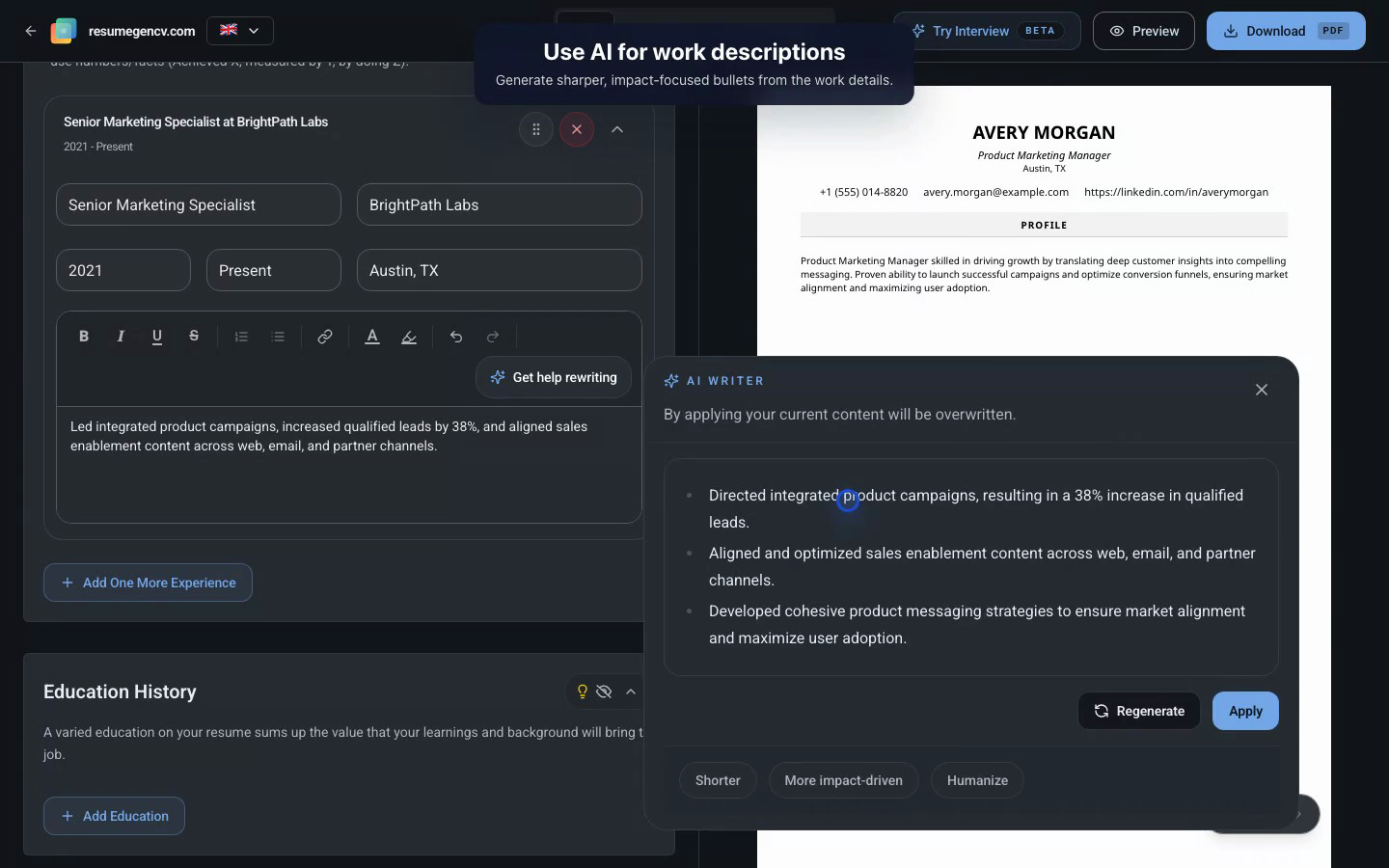
Built weekly customer health reports in Looker for 6 account managers, helping the team identify renewal risks earlier and prioritize outreach.
The stronger bullet does not need a dramatic metric. It gives action, tool, audience, and business use.
3. Can the file be read?
A resume that looks beautiful but parses badly is risky.
Use:
- standard section labels
- plain text for job titles, employers, dates, and skills
- consistent spacing
- readable font sizes
- simple bullets
- predictable date formats
- clear contact information
Avoid putting critical information only inside:
- images
- icons
- complex tables
- text boxes
- decorative columns
- headers or footers that may be skipped
If the application matters, export the final file and run it through an ATS scanner. Scan the actual PDF you plan to send, not a screenshot or a draft.
4. Can you defend the story in an interview?
Every strong resume creates interview questions.
If your bullet says you "led migration strategy," be ready to explain:
- what changed
- why the migration mattered
- what options you considered
- what tradeoffs you made
- what went wrong
- what result followed
If you cannot discuss a bullet for two minutes, rewrite it. If you cannot explain a skill honestly, remove it or reframe it as exposure.
Your resume should help you get the interview, but it should also help you survive the interview.
The Best Resume Structure
There is no single perfect order for every person, but this structure works for many job applications:
- Contact details
- Targeted summary
- Key skills or tools
- Work experience
- Projects, if relevant
- Education
- Certifications, awards, volunteering, or additional sections
Adjust the order based on what proves fit fastest.
For example:
- A student may move education and projects higher.
- A career changer may use a targeted summary and selected projects.
- A senior leader may emphasize scope, teams, strategy, and outcomes.
- An academic CV may put education, appointments, publications, research, and teaching in a different order.
The rule is simple:
Put the strongest relevant evidence where the reader will see it first.
Contact Details: Boring, But Easy To Break
Your contact section should be clean and boring.
Include:
- name
- phone number
- professional email
- city or region
- LinkedIn, if useful
- portfolio, GitHub, writing samples, or personal site, if relevant
Avoid:
- full street address unless required
- personal email handles that look unprofessional
- too many links
- social profiles that do not support the application
- icons that replace labels entirely
Use normal text. Recruiters should not need to guess whether an icon is a portfolio, LinkedIn, email, or phone number.
The Summary: A Positioning Tool, Not A Personality Statement
A resume summary should not be a pile of adjectives.
Weak:
Motivated, detail-oriented, passionate professional with excellent communication skills and a proven track record.
Better:
Customer success manager with 5 years of B2B SaaS experience supporting enterprise accounts, improving onboarding processes, and using product usage data to reduce churn risk.
The better summary gives:
- role
- years or level
- domain
- type of work
- proof categories
Use this formula:
[Role or target role] with [experience/context] in [domain], focused on [2-3 job-relevant strengths].
Examples:
- Entry-level data analyst with internship and project experience in SQL, dashboarding, and customer behavior analysis.
- Operations manager with experience improving scheduling, vendor coordination, and frontline team processes across multi-site service teams.
- Frontend engineer focused on React, accessibility, performance, and design-system implementation for product teams.
- Career-changing project coordinator with a background in hospitality operations, scheduling, customer communication, and cross-functional problem solving.
Keep the summary short. If it becomes a paragraph of everything you have ever done, it stops working.
Work Experience: Write Evidence, Not Duties
Most weak resumes describe responsibilities. Strong resumes describe evidence.
Use this bullet structure:
Action + object + context + result
You do not need all four pieces in every bullet, but most strong bullets include at least three.
Examples:
| Weak | Stronger |
|---|---|
| Managed social media | Planned and published LinkedIn content for a B2B SaaS brand, increasing qualified demo traffic from organic posts |
| Helped with reports | Automated weekly sales reporting in Google Sheets, reducing manual updates and giving managers a clearer pipeline view |
| Worked with customers | Resolved billing and onboarding issues for 40-60 customers per week while documenting recurring product friction for the support team |
| Improved website | Rebuilt landing page sections with clearer messaging and faster load times, supporting a higher trial signup rate |
When possible, add numbers. When numbers are not available, add scale, frequency, audience, tools, or stakes.
Do not fake metrics. A truthful bullet with useful context is stronger than a fake number.
Skills: Do Not Create A Keyword Graveyard
A skills section should help a reader scan fit. It should not be a landfill of every word from the job description.
Good skills sections are:
- grouped
- relevant
- honest
- supported elsewhere in the resume
Example:
Analytics: SQL, Looker, GA4, funnel analysis, cohort analysis
Product: roadmap support, user research synthesis, experiment tracking
Communication: stakeholder reporting, executive summaries, customer interviews
If a skill matters to the job, it should appear in the skills section and show up in the experience or project section. That connection is what makes the keyword believable.
Use Resume Skills Check when you need to find missing, buried, or weakly supported skills.
Education: More Important Early, Cleaner Later
Education changes weight over time.
If you are early in your career, education may carry more of the resume. Include:
- degree or program
- school
- graduation date or expected date
- relevant coursework
- honors
- academic projects
- student leadership
If you have several years of relevant experience, education usually becomes shorter. Keep the degree, institution, and relevant credentials. Move the professional proof higher.
For academic CVs, education can remain central, especially for graduate programs, research, teaching, fellowships, or academic roles.
Projects: The Underrated Section
Projects are powerful when experience is thin, changing direction, or hard to explain.
A good project entry should include:
- the problem
- your role
- tools or methods
- what you built or analyzed
- outcome or learning
- link, if available
Weak:
Portfolio website
Stronger:
Built a React portfolio site with case-study pages, responsive layouts, and Lighthouse performance checks to present design and frontend projects to hiring teams.
Projects are especially useful for:
- students
- bootcamp graduates
- career changers
- developers
- designers
- data analysts
- marketers
- writers
- product candidates
If the project proves the job requirement, it belongs.
ATS Readability: What Actually Matters
Applicant tracking systems vary. No tool can guarantee how every employer's system will process every file. But you can reduce obvious risk.
The safest resume choices are:
- standard headings like Experience, Education, Skills, Projects
- normal text for important content
- simple layout
- consistent dates
- clear job titles
- bullet points instead of dense paragraphs
- text-based PDF when PDF is accepted
- DOCX only when the employer asks for it
The risky choices are:
- putting text inside images
- complex two-column layouts
- tables for core experience
- icons instead of labels
- unusual section names
- tiny fonts
- decorative graphics around important text
If an employer requires a specific format, follow the employer's instructions. If both PDF and DOCX are allowed, send the cleanest version and verify that it uploads correctly.
Resume Job Match: The Missing Middle Step
Many candidates jump from "write resume" to "apply." The missing step is job matching.
Job matching asks:
- Does the resume reflect the actual job description?
- Which required skills are missing?
- Which strengths are buried?
- Which bullets need more proof?
- Does the summary point toward this role?
- Are the strongest examples near the top?
This is where applications improve quickly.
You do not need to rewrite the entire resume for every job. You usually need to adjust:
- summary
- skills section
- 3-5 top bullets
- project order
- keywords that are true and supported
- cover letter context
Use Resume Job Match when you want a structured comparison before applying.
Cover Letter: Only Useful When It Adds Context
A cover letter should not repeat the resume in paragraph form.
Use a cover letter to answer:
- Why this role?
- Why this company or team?
- Why does your background make sense?
- What context would be hard to show in the resume?
- What proof should the reader notice first?
Good cover letters are specific. Bad cover letters are generic compliments.
Simple structure:
- Name the role and your strongest fit.
- Connect 1-2 examples from your background to the job.
- Add context the resume cannot easily show.
- Close with interest in the conversation.
Example opening:
I am applying for the Customer Success Manager role because my last three years have focused on onboarding process improvement, account health reporting, and reducing renewal risk for B2B SaaS customers.
That opening is better than:
I am excited to apply because I am passionate, hardworking, and believe I would be a great fit.
Use the cover letter guide when you need a targeted letter for a real application.
Peer Review: Ask Better Questions
Resume feedback fails when you ask, "Does this look good?"
Ask sharper questions:
- What job does this resume look built for?
- Which bullet is strongest?
- Which section feels confusing?
- What proof is missing?
- What should move higher?
- What can I remove?
- Where do you stop trusting the story?
The best reviewers are not always professional resume writers. A useful review group might include:
- someone who knows the target role
- someone who writes clearly
- someone who does not know your background
- someone who has hired for similar work
Look for patterns. One comment can be taste. Repeated comments are signal.
Use Peer Review if you want a single reviewable resume link instead of scattered screenshots and file versions.
Interview Prep Starts Before The Interview
Your resume is an interview script.
Every bullet should point to a story you can tell:
- situation
- task or problem
- action
- tradeoff
- result
- lesson
Before an interview, mark the 6-8 resume bullets most likely to trigger questions. For each one, write a short answer:
- What was happening?
- What did I personally do?
- What was difficult?
- What changed?
- What would I do differently?
Also prepare for:
- "Walk me through your resume."
- "Why this role?"
- "Tell me about a time you handled conflict."
- "What project are you proud of?"
- "What is a weakness or gap in your background?"
- "Why are you leaving your current role?"
The best interview answers are not memorized speeches. They are structured stories you can adapt.
Use Interview Prep after tailoring your resume so the practice questions match the application you actually sent.
The Career Story Layer
A resume is stronger when it has a career story.
That does not mean every move was planned. It means the reader can understand the direction.
Ask:
- What kind of work am I moving toward?
- What problems do I solve best?
- What evidence supports that direction?
- What do I want the interviewer to remember?
- What gaps need context?
For example:
Weak story:
I have done support, operations, some analytics, and project coordination.
Stronger story:
My background is in operational problem solving: I have supported customers, improved internal processes, built reports, and coordinated cross-functional work. I am now targeting operations analyst and project coordination roles where those strengths combine.
The work history is the same. The second version gives the reader a path.
What To Remove From A Resume
Good editing is deletion.
Remove or shorten:
- old work that does not support the target
- generic soft-skill claims without proof
- repeated bullets
- dense paragraphs
- irrelevant coursework
- tools you cannot discuss
- personal details not needed for the role
- objective statements that only say you want a job
- references available upon request
Your resume is not an archive. It is a selection.
A Practical Resume Quality Checklist
Use this before applying.
Target
- The target role is clear in the top third.
- The summary matches the job.
- The strongest evidence appears early.
- The resume is not trying to serve five different job families at once.
Evidence
- Bullets show actions, context, and results.
- Important skills are supported by examples.
- Metrics are truthful and useful.
- Projects or certifications are included only when they help.
Readability
- Contact information is easy to find.
- Section headings are standard.
- Dates and job titles are consistent.
- Font size is readable.
- The exported PDF is checked.
Job Match
- Required skills from the job are visible.
- Missing skills are handled honestly.
- Keywords appear naturally.
- The resume is tailored without becoming fake.
Interview Readiness
- You can explain every major bullet.
- You know which stories support the target role.
- You can answer "walk me through your resume."
- Your cover letter and LinkedIn do not contradict the resume.
A 60-Minute Workflow For One Important Application
If you have one job you really care about, use this workflow.
Minutes 0-10: Read The Job
Highlight responsibilities, required skills, seniority signals, repeated words, and company context.
Minutes 10-25: Reorder The Resume
Move the most relevant bullets and projects higher. Remove details that distract from the role.
Minutes 25-35: Rewrite The Top Third
Adjust the summary and skills section so the target role is obvious.
Minutes 35-45: Improve The Best Bullets
Rewrite 3-5 bullets using action, context, and result. Add tools, scale, or proof where useful.
Minutes 45-50: Scan The File
Export the resume and check readability. Fix broken parsing, missing sections, or formatting risks.
Minutes 50-55: Write The Cover Letter
Use the letter to explain why your strongest evidence matters for this role.
Minutes 55-60: Prepare Interview Notes
Write short notes for the 3 stories most likely to come up.
That is the full application loop.
The Standard Is Alignment
The best job applications are aligned.
The resume says: here is the proof.
The CV says: here is the full record, when a full record is needed.
The cover letter says: here is why this proof matters for this role.
The portfolio says: here is the work.
The interview says: here is the story behind it.
If those pieces point in different directions, the reader hesitates. If they point in the same direction, the application feels easier to trust.
That is the real resume standard.
Build a clear document. Match it to the job. Scan the file. Get feedback. Prepare the story. Then apply with something you can stand behind.
Continue The Conversation On LinkedIn
Read and share the companion LinkedIn article: The Resume Standard for 2026: Your Resume Is Evidence, Not a Biography.
Sources And Further Reading
- Harvard College: Create a Strong Resume
- Purdue OWL: Resumes and CVs
- Purdue OWL: Writing the Curriculum Vitae
- NACE: Career Readiness Competencies
Build Your Application Package
Do not treat these as separate chores. Treat them as one application loop: build the case, test it against the job, fix the weak spots, and prepare the story behind the proof.
That is the loop ResumeGenCV is built to close: