ATS Resume Tips
AI Resume Screening: Prove Your Skills in 2026
AI did not make resumes less important.
It made weak resumes easier to produce.
That is why the strongest job applications in 2026 do not just sound polished. They prove skill. They show the hiring system the right language, show the recruiter the right signals, and give the hiring manager enough evidence to believe the candidate can do the work.
This matters because the hiring market has changed in two directions at once:
- Candidates can generate polished resumes and cover letters faster than ever.
- Employers are responding by verifying skills more carefully.
Robert Half's 2026 hiring research reports that AI-generated applications are creating more work for hiring teams, with many HR leaders saying the added review burden has increased time-to-hire. PwC's 2026 AI Jobs Barometer says skills in AI-exposed roles are changing more than twice as fast as skills in less-exposed roles. The World Economic Forum names AI, big data, cybersecurity, technology literacy, creative thinking, resilience, and agility among the skills shaping work through 2030.
The lesson for job seekers is not "trick the algorithm."
The lesson is simpler and harder:
Write a resume that can be parsed by machines, understood by recruiters, and defended by you in an interview.
That is the new standard.
What AI Resume Screening Usually Means
"AI resume screening" is not one single tool.
In real hiring workflows, the first pass can include several layers:
| Layer | What it may do | What your resume needs |
|---|---|---|
| ATS parsing | Reads contact info, sections, dates, titles, skills, and education | Clean formatting, standard headings, readable text |
| Keyword matching | Compares resume language to the job description | Natural role-specific terms, not keyword stuffing |
| Semantic search | Looks for related experience, not just exact words | Clear context around skills and responsibilities |
| Recruiter skim | Human scan for fit, gaps, and obvious mismatches | Strong top third, relevant titles, proof early |
| Hiring manager review | Checks whether the evidence matches the job | Specific bullets, scope, outcomes, and judgment |
| Interview verification | Tests whether you can explain the work | Honest claims and ready stories |
The mistake is treating AI screening like a lock with a secret code.
Modern hiring is more like a sequence of trust checks. Each step asks a slightly different question:
- Can the system read this resume?
- Does the resume look relevant to this role?
- Does the candidate appear to have done similar work?
- Can the candidate explain the work without hiding behind vague language?
- Is there enough evidence to spend interview time here?
Your resume has to answer all five.
Why This Topic Is Trending Now
Search interest around AI resume screening, AI resume checkers, ATS-friendly resumes, and skills-based hiring is rising because candidates are feeling the same pressure from both sides.
On one side, job seekers are told to tailor every application. On the other side, job posts are getting longer, more repetitive, and sometimes written with AI themselves. Candidates want to know which keywords matter, which tools matter, and whether AI is silently rejecting them.
The better question is:
What proof should your resume show when hiring teams are drowning in polished but shallow applications?
That is where skills-based hiring changes the game.
Skills-based hiring does not mean degrees, titles, and company names no longer matter. They still do. But employers are increasingly trying to identify what a candidate can actually do: solve problems, communicate, use tools, lead work, learn quickly, manage ambiguity, and produce results.
For the resume, that means your skills section is only the start.
The real proof lives in the bullets.
The Skills-Based Resume Formula
Most resumes list skills like this:
| Weak version | Why it falls flat |
|---|---|
| Project management, communication, Excel, Salesforce, leadership | The reader sees labels, not proof |
| Data analysis, dashboards, reporting, stakeholder management | Better keywords, but still no evidence |
| AI tools, ChatGPT, automation, prompt engineering | Current, but easy to overclaim |
A skills-based resume connects each important skill to a real example.
Use this formula:
Skill + context + action + result + proof you can discuss
Here is what that looks like:
| Resume element | Question it answers | Example |
|---|---|---|
| Skill | What ability is relevant? | Customer onboarding |
| Context | Where did you use it? | B2B SaaS accounts after handoff from sales |
| Action | What did you do? | Built a 30-day onboarding checklist and health-score review |
| Result | What changed? | Reduced early churn risk and improved activation timing |
| Interview story | Can you explain it? | Tradeoffs, stakeholders, metrics, mistakes, next steps |
Now the resume is not just saying "customer success." It is proving a customer success skill in a way a recruiter and hiring manager can believe.
The New Top Third Of The Resume
The top third of your resume is now more important than ever because both humans and systems use it to orient themselves.
For most candidates, the top third should include:
- Name, contact details, and LinkedIn or portfolio if relevant.
- Target title or clear professional headline.
- A short summary that names role fit, scope, and strongest evidence.
- A skills section grouped around the job's core requirements.
Weak summary:
Motivated and hardworking professional with strong communication skills seeking a challenging role where I can grow and contribute.
Stronger summary:
Customer Success Manager with 4 years supporting B2B SaaS accounts, improving onboarding workflows, tracking account health, and partnering with sales and product teams to reduce renewal risk.
The stronger version works because it answers immediate questions:
- What role does this person fit?
- What type of environment have they worked in?
- What problems have they handled?
- Which keywords are present naturally?
- What should I look for in the experience section?
That is not keyword stuffing. That is orientation.
How To Read A Noisy Job Description
Many job descriptions in 2026 are too long.
Some are written by committee. Some are recycled from older postings. Some are inflated wish lists. Some include AI-generated language that repeats the same idea in different words.
Do not treat every line as equally important.
Separate the posting into five layers:
| Layer | What to look for | Resume response |
|---|---|---|
| Must-have work | Tasks repeated in responsibilities and requirements | Make these visible in summary and bullets |
| Tools and systems | Software, platforms, methods, frameworks | Include only tools you can use and explain |
| Business outcomes | Revenue, cost, quality, speed, retention, risk | Tie bullets to those outcomes |
| Seniority signals | Own, lead, build, influence, define, mentor | Show scope, judgment, and decision-making |
| Nice-to-have noise | Long lists, rare tools, vague traits | Address only if true and relevant |
If the job post says "cross-functional collaboration" five times, do not just add that phrase to a skills list. Show where you worked with sales, product, engineering, finance, operations, customers, or executives.
If the job post says "AI tools," do not write "AI expert" unless that is true. Say exactly how you used AI:
- used AI to draft first-pass research summaries
- reviewed AI output for accuracy before client delivery
- built prompt templates for repeat support workflows
- used automation to reduce manual reporting time
- evaluated AI outputs against policy, quality, or compliance rules
Specific beats impressive.
The Proof Ladder
A useful resume does not claim everything with the same force.
Use a proof ladder.
| Proof level | Resume signal | Best for |
|---|---|---|
| Exposure | "Supported," "assisted," "used in coursework" | Early-career, career change, adjacent skills |
| Working ability | "Managed," "built," "analyzed," "resolved" | Core skills you have used independently |
| Ownership | "Led," "owned," "designed," "launched" | Seniority, responsibility, promotion readiness |
| Measured impact | "Reduced," "increased," "saved," "improved" | Results-driven bullets |
| Transferable judgment | "Prioritized," "negotiated," "diagnosed," "recommended" | Human skills employers verify in interviews |
This matters because AI has made it easy to overstate ability. Hiring teams know that. A resume that calmly distinguishes exposure from ownership feels more credible than a resume that pretends every skill is expert-level.
Example:
Weak:
- Expert in AI automation, analytics, stakeholder management, and strategic leadership.
Better:
- Built a weekly account-health report in Salesforce and Sheets, then used AI-assisted summaries to flag renewal risks for customer success managers.
Best:
- Built a weekly account-health report across Salesforce and Sheets, using AI-assisted summaries reviewed against account notes to flag renewal risks and help CSMs prioritize outreach for 60+ active accounts.
The best version is not louder. It is more concrete.
What To Put In The Skills Section
A modern skills section should not be a junk drawer.
Group skills by hiring intent.
For example, a marketing operations resume might use:
| Skill group | Examples |
|---|---|
| Marketing operations | Campaign operations, lead routing, lifecycle reporting, segmentation |
| Tools | HubSpot, Salesforce, Marketo, GA4, Looker Studio |
| Data and automation | SQL basics, dashboard QA, workflow automation, attribution reporting |
| Collaboration | Sales alignment, stakeholder updates, agency coordination |
A software engineering resume might use:
| Skill group | Examples |
|---|---|
| Languages | TypeScript, Python, SQL |
| Frontend | React, Next.js, accessibility, design systems |
| Backend | Node.js, PostgreSQL, REST APIs, queues |
| AI and data | LLM APIs, embeddings, evaluation, prompt testing |
| Practices | Code review, incident response, testing, documentation |
Avoid:
- long alphabetical lists with no priority
- soft skills with no proof
- tools you touched once and cannot explain
- fake "expert" language
- adding every keyword from the job post
Use the skills section to help matching. Use the experience section to prove the match.
Bullet Examples That Survive AI And Human Review
Here are practical before-and-after examples.
Customer Success
Weak:
- Responsible for onboarding customers and building relationships.
Better:
- Managed onboarding for B2B SaaS customers, coordinating kickoff calls, training sessions, and adoption follow-ups.
Best:
- Managed onboarding for 35+ B2B SaaS customers, creating a 30-day checklist and health-score review that helped CSMs identify adoption risks before renewal conversations.
Why it works:
- names the role context
- includes scale
- shows process
- connects to a business risk
- gives the interviewer something to ask about
Data Analyst
Weak:
- Created reports and dashboards for leadership.
Better:
- Built weekly dashboards in Tableau to track sales pipeline, conversion rates, and regional performance.
Best:
- Built Tableau dashboards for sales leadership, combining CRM and finance data to track pipeline movement, conversion rates, and regional performance across 4 markets.
Why it works:
- includes tool, audience, data sources, metrics, and scope
Administrative Assistant
Weak:
- Organized calendars, meetings, and documents.
Better:
- Coordinated calendars, meeting logistics, and document workflows for a 12-person operations team.
Best:
- Coordinated calendars, travel, meeting logistics, and document workflows for a 12-person operations team, reducing scheduling conflicts by centralizing requests and weekly priority updates.
Why it works:
- turns routine work into operational proof
Entry-Level Candidate
Weak:
- Strong communication, teamwork, and leadership skills.
Better:
- Led a 5-person class project, coordinating weekly check-ins, dividing research tasks, and presenting findings to faculty.
Best:
- Led a 5-person research project on customer retention, coordinating weekly check-ins, dividing analysis tasks, and presenting recommendations that earned top marks from faculty reviewers.
Why it works:
- proves teamwork and communication without generic traits
Career Changer
Weak:
- Seeking to transition into project management with transferable skills.
Better:
- Coordinated scheduling, vendor communication, and issue resolution for multi-location retail operations.
Best:
- Coordinated vendor communication, staffing updates, and issue resolution across 3 retail locations, building a weekly tracker that improved handoffs between store managers and regional operations.
Why it works:
- shows the project-management behavior before claiming the new title
How To Show AI Skills Without Sounding Fake
AI skills are becoming more visible in job posts, but many candidates write about them badly.
Do not write:
- AI expert
- prompt guru
- ChatGPT power user
- automated everything with AI
- used AI to optimize workflows
Those phrases are too broad. They create skepticism.
Write what you actually did:
| Weak AI claim | Stronger resume proof |
|---|---|
| Used AI to improve productivity | Used AI-assisted research drafts to prepare first-pass competitor summaries, then verified claims against source documents |
| Automated reporting with AI | Built a template that turned weekly support-ticket exports into reviewed summary notes for the customer success team |
| Expert prompt engineer | Created reusable prompt patterns for support macros, reducing rewrite time while keeping manager review before publishing |
| Used AI in marketing | Tested AI-generated email variants, reviewed brand compliance, and selected final copy based on campaign goals |
The key is review.
If your AI work involved accuracy, judgment, quality control, compliance, customer safety, brand voice, or stakeholder review, say that. Employers are not only looking for people who can type prompts. They are looking for people who can use tools responsibly.
The Human Skills AI Makes More Important
The more AI handles routine output, the more employers test the human layer around that output.
That includes:
- judgment
- communication
- prioritization
- customer empathy
- ethical reasoning
- stakeholder management
- creativity
- resilience
- learning agility
- accountability
This aligns with the direction of major labor-market research. PwC's 2026 AI Jobs Barometer notes that AI-exposed roles are adding more human-intensive skills. NACE's career readiness framework continues to emphasize communication, critical thinking, teamwork, professionalism, technology, leadership, and career development.
On your resume, human skills should appear through situations.
Weak:
- Excellent communicator with strong problem-solving skills.
Better:
- Resolved recurring customer escalation pattern by documenting root causes, aligning support and product teams, and updating response guidance for frontline agents.
The second version proves communication and problem-solving without naming either one.
ATS Formatting Still Matters
Even with AI, basic ATS readability is still the floor.
Use:
- standard section headings like Work Experience, Education, Skills, Projects, Certifications
- simple bullet points
- readable fonts
- consistent dates
- text-based content, not screenshots
- one-column formatting for maximum safety
- common file types requested by the employer, usually PDF or DOCX
Avoid:
- important text inside images
- heavy tables for core resume content
- headers or footers that contain critical contact details
- unusual section names that hide important information
- keyword blocks with no context
- white text keyword stuffing
If you want a quick pass, use the ATS Scanner to check whether your resume is readable and likely to parse cleanly.
How To Tailor Without Lying
Good tailoring is selection, emphasis, and translation.
Bad tailoring is invention.
Use this three-part test before adding any phrase from a job description:
- Have I actually done this?
- Can I give a specific example?
- Could I answer follow-up questions about tradeoffs, tools, mistakes, or results?
If yes, include it.
If partly, phrase it honestly:
- "Supported"
- "Assisted"
- "Contributed to"
- "Used in coursework"
- "Built a personal project using"
- "Partnered with"
- "Familiar with"
If no, leave it out and decide whether to learn it before applying to similar roles.
Honest specificity beats borrowed language.
A 45-Minute Workflow For One Application
Here is a practical workflow when you find a role worth applying to.
1. Decode The Job Description
Spend 10 minutes pulling out:
- 5 core responsibilities
- 5 required skills
- 3 tools or systems
- 3 business outcomes
- 2 seniority signals
Ignore filler phrases for now.
2. Build A Proof Map
Make a table:
| Job requirement | My proof | Resume location |
|---|---|---|
| Customer onboarding | Built onboarding checklist for 35+ accounts | Summary, Experience bullet 1 |
| Account health reporting | Weekly Salesforce and Sheets report | Skills, Experience bullet 2 |
| Cross-functional work | Partnered with sales and product on renewal risks | Experience bullet 3 |
If you cannot map proof to a requirement, that is a real gap. Do not hide it. Decide whether the gap matters.
3. Rewrite The Top Third
Update:
- target headline
- summary
- skills groups
- first two bullets under the most relevant role
Do not rewrite the entire resume if the top proof is already strong.
4. Improve 3-5 Bullets
Focus on bullets that map to the job's must-have work.
Use:
Action + context + method/tool + outcome
Example:
- Built a renewal-risk tracker across Salesforce notes, support tickets, and account health scores, helping CSMs prioritize outreach before quarterly business reviews.
5. Check ATS And Job Match
Run your resume through:
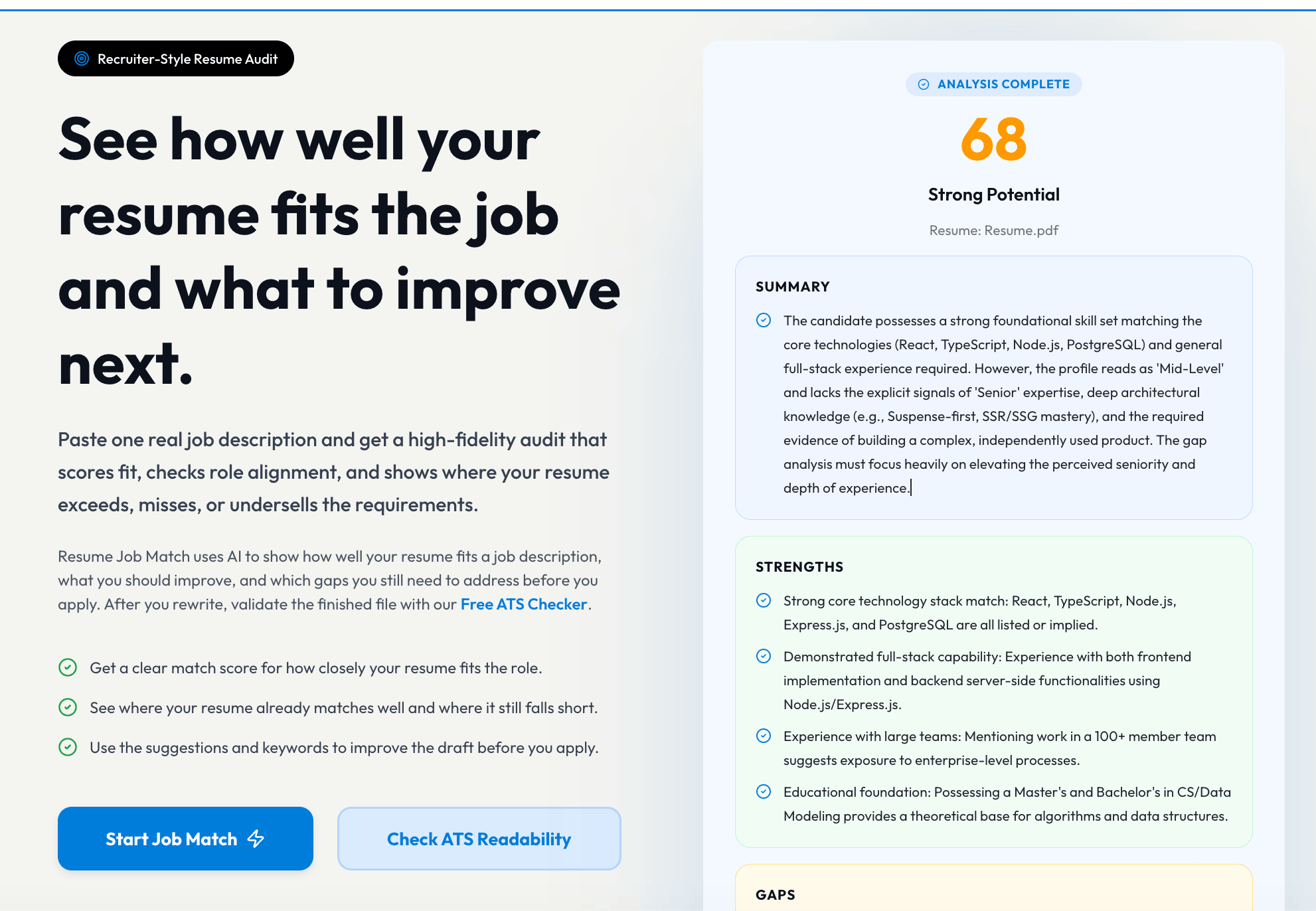
- Resume Job Match to compare it with the role
- Resume Skills Check to see whether skills are visible
- ATS Scanner to catch formatting and parsing issues
Use the tools to find gaps, then make human decisions. Do not let any checker push you into dishonest keywords.
6. Prepare Interview Proof
For every major claim in the resume, prepare a 60-90 second explanation:
- What was the situation?
- What was your responsibility?
- What did you do?
- What changed?
- What would you do differently now?
This closes the loop between resume, screening, and interview.
Use Interview Prep if you want practice turning resume bullets into answers.
The Resume Sections That Need The Most Work
If you only have time to improve five areas, improve these.
1. Summary
Make it role-specific and evidence-based.
Bad:
- Experienced professional seeking new opportunities.
Good:
- Operations coordinator with 5 years managing schedules, vendor communication, inventory updates, and cross-team issue resolution for multi-location retail teams.
2. Skills
Group by job relevance, not alphabet.
Bad:
- Excel, communication, leadership, Salesforce, reports, teamwork, AI, dashboards.
Good:
- Operations: scheduling, vendor coordination, inventory updates, issue tracking
- Tools: Excel, Salesforce, Asana, Google Workspace
- Reporting: weekly status updates, dashboard QA, process documentation
3. Recent Role Bullets
The most recent relevant role should carry the most proof.
Bad:
- Responsible for reports and stakeholder updates.
Good:
- Produced weekly operations reports for 4 regional managers, combining staffing, inventory, and issue-tracking data to surface risks before Monday planning meetings.
4. Projects
Projects are powerful for career changers, early-career candidates, and technical roles.
A useful project entry includes:
- problem
- tools
- your role
- result
- link, if public
5. Certifications And Learning
Certifications help when the job values a tool, method, or regulated skill.
But do not let a certification replace proof. Pair it with a project, work example, or measurable use.
Common Mistakes In AI-Screened Resumes
Mistake 1: Writing For The Tool Only
If your resume is readable to a system but boring to a human, it will still fail.
Fix it by adding context, scope, and outcomes.
Mistake 2: Copying The Job Description Too Closely
Mirroring exact language can help when it is true and natural. Copying whole phrases everywhere makes the resume feel fake.
Fix it by translating requirements into your real experience.
Mistake 3: Listing AI Skills Without Evidence
AI keywords are easy to add and easy to question.
Fix it by showing how you used AI, what you reviewed, and what decision improved.
Mistake 4: Hiding Transferable Skills
Career changers often undersell useful experience because it came from another industry.
Fix it by naming the behavior:
- coordinated
- analyzed
- prioritized
- documented
- trained
- resolved
- presented
- improved
Mistake 5: Making Every Bullet A Metric
Metrics help, but not every job produces clean numbers.
Fix it by using credible evidence:
- frequency
- volume
- audience
- scope
- tools
- risk reduced
- process improved
- decision supported
A Better Resume Checklist For 2026
Before you apply, check this:
- The job target is obvious in the first 10 seconds.
- The top third includes the role's main keywords naturally.
- The skills section is grouped, not dumped.
- The first role has 3-5 bullets that prove must-have work.
- Bullets include context, tools, scope, or results.
- AI skills are specific and honest.
- Human skills are shown through examples.
- Formatting is ATS-readable.
- There is no hidden keyword stuffing.
- Every major claim can survive interview follow-up.
- The resume, cover letter, LinkedIn, portfolio, and interview stories tell the same story.
That last point is the part many candidates miss.
A resume is not a standalone artifact anymore. It is the front door to a larger proof system.
Frequently Asked Questions
Do companies really use AI to screen resumes?
Some do, some do not, and many use a mix of ATS search, keyword filters, recruiter review, and hiring-manager evaluation. You should not assume a robot is automatically rejecting you, but you should make your resume easy for systems to parse and easy for humans to trust.
Should I use an AI resume writer?
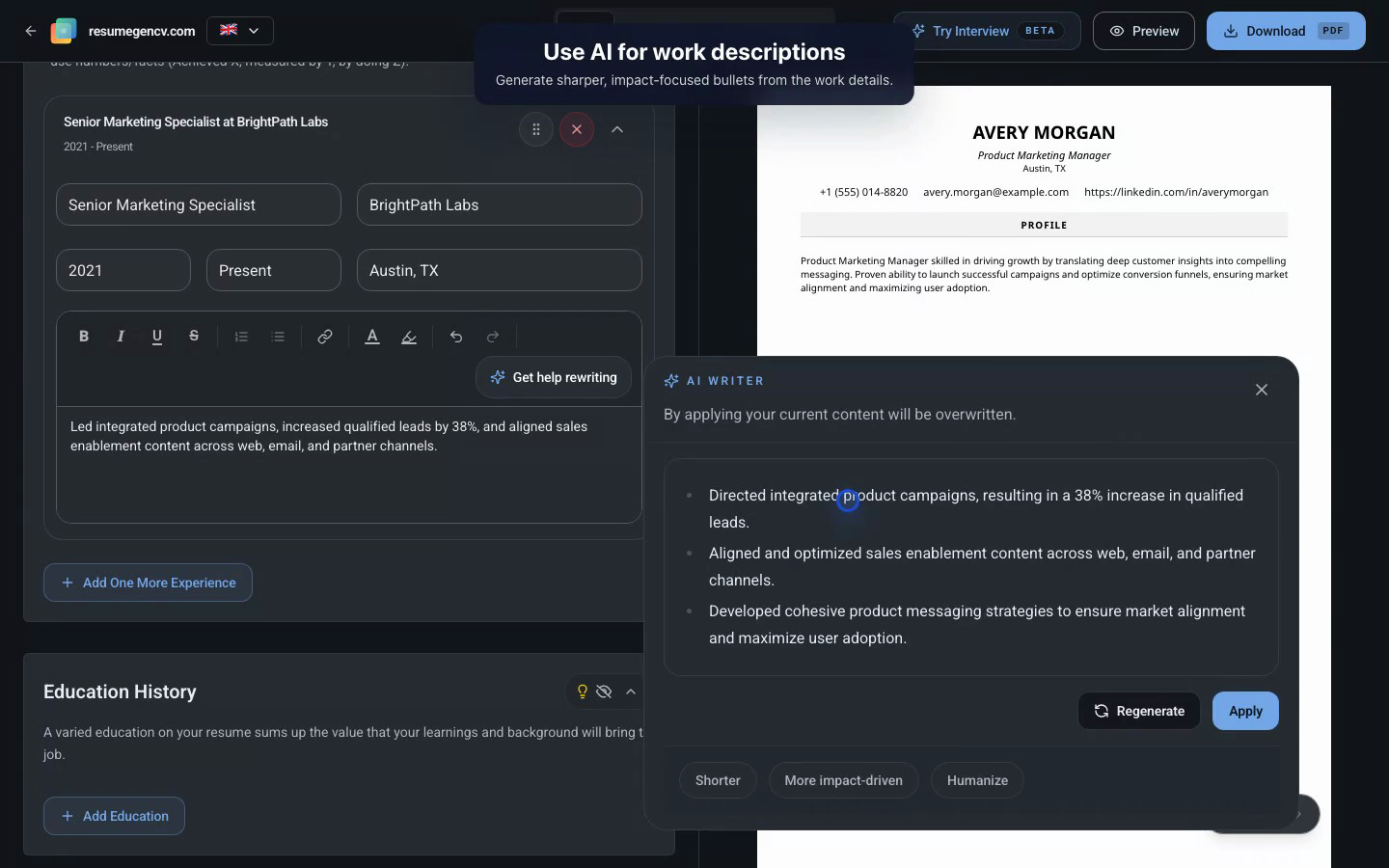
You can use AI as an editor, brainstorming partner, or job-description analyzer. Do not let it invent experience, exaggerate tools, or turn your resume into generic corporate language. The final resume has to be true enough for an interview.
How many keywords should I include?
Include the important terms you can honestly prove. Focus on repeated responsibilities, required tools, role-specific methods, and business outcomes. A smaller set of accurate keywords with evidence is better than a long keyword list.
Is a skills-based resume better than a chronological resume?
For most candidates, the best format is still reverse chronological, but written with skills-based proof. That means your work history stays clear while the summary, skills section, and bullets are tailored around the role's core skills.
How do I prove skills if I am entry-level?
Use internships, coursework, projects, volunteer work, part-time jobs, student leadership, certifications, and personal projects. The proof does not need to come from a full-time job, but it does need to be specific.
Should I mention ChatGPT or AI tools on my resume?
Mention AI tools only when they are relevant to the role and you can explain how you used them. Strong examples show judgment: how you reviewed output, protected quality, saved time, improved research, or supported a workflow.
Sources And Further Reading
- Robert Half: AI in Recruiting: Why Hiring is Harder in 2026
- Robert Half press release on AI-generated applications and hiring delays
- PwC: 2026 AI Jobs Barometer
- PwC: AI and the future of entry-level work
- World Economic Forum: Future of Jobs Report 2025
- NACE: Career Readiness Defined
- NACE: High-Impact Skills College Students Should Showcase on Their Resumes
The Bottom Line
The winning resume in 2026 is not the loudest resume, the prettiest resume, or the resume with the most AI-generated polish.
It is the resume that makes skill visible.
Use AI to research and edit. Use ATS rules to keep the document readable. Use skills-based proof to make the case. Then make sure every claim is strong enough to explain in the interview.
That is how you pass the first screen without losing the human one.
Use Resume Job Match to find the role gaps, Resume Skills Check to make your skills visible, and ATS Scanner to make sure the document can be read cleanly.